In modern times, where a positive mindset is essential to succeed in the extremely competitive market, most people still struggle with their beliefs and subconscious limits. Despite all the available resources, such as books, seminars, and systematic growth programs, many professionals struggle to make the shift. What’s unpleasant and very common is that often people get stuck in the Motivation Loop that leads to more vulnerable positions.
The question is, why does this happen? Most of the programs focus on the symptoms, whereas the problems lie within their upbringing, life hardships, and value system
Here comes the NLP Therapy or Neuro-Linguistic Programming, which is a powerful psychological framework that reprograms the mind for transformation. If you’re one of the people searching for a real, impactful change, NLP can provide you with an actionable solution for long-term, solidified results.
Read the blog till the end, and you’ll find out what people actually miss and how NLP can hit the mark.
What Is Mindset and Why Does It Matter?
The term mindset refers to the specific set of individual beliefs, attitudes, and behaviour frameworks that decide how a person perceives, interprets, and responds to the world.
According to the famous psychologist Carol Dweck, Mindsets are just beliefs. They’re powerful beliefs, but they’re just something in your mind, and you can change your mind.
People with rigid beliefs often have a static or fixed mindset, whereas people who view challenges as opportunities for development enjoy a growth mindset. Notably, people with a growth-oriented mindset often drive resilience, adaptability, and innovation. These qualities are critical in dynamic fields like business, corporate, and leadership roles.
Now, why does a growth mindset matter?
A fixed or limited mindset often continues the cycles of underachievement and always tries to avoid the risks and miss opportunities that are essential to their career growth.
Now, here’s a note. Your mind is powerful enough to rewire itself with a positive attitude and critical thinking. In short, mastering ‘how do you change your mindset’ is the key to thriving in modern times.
Also Read: Neuro Linguistic Programming: Does It Really Work?
Why Most People Fail to Change Their Mindset?
Unlike what most people assume, changing your mindset isn’t always about replacing your companionships, reading books, and participating in activities. It’s actually deep-rooted psychological and neurological barriers. These are mind patterns, and you need to examine your mind processes to understand and remove these barriers.
- Old Habits and Conditioning
Most of our old habits are the result of neurons working and winding together. This takes months and years of conditioning. As a result, childhood conditioning, societal norms, and repeated behaviours bind your mindset more than you can ever imagine.
- Fear of Change
We have special organs in our brains called the amygdala that are responsible for a primal fight-or-flight response. It is also responsible for emotional stability, fear, comfort, and convenience, memories, decision-making, etc.
Any kind of change in behaviour triggers this and makes you feel uncomfortable. This fear of change leads to procrastination or rationalisation. In a world where our minds are shaped for survival, novelty often feels threatening. Notably, this is very common in today’s professionals as well, where they stick to one pattern and fear for change.
- Negative Self-Talk
Most people don’t even notice this, but negative self-talk often hinders their best potential. Phrases like ‘I am not good enough’ cling to their minds and never let people try, fail, learn, and grow. The negative self-talk also boosts cortisol levels and affects decision-making and motivation.
- Lack of Awareness
Metacognition is the ability to observe one’s thoughts and analyse them without any bias. People who lack this ability lack awareness and often work with limiting beliefs. These are like hidden software glitches.
- Inconsistent Effort
Changing your mindset is possible, but it demands consistent efforts. Why? Our mind creates patterns based on regular, repetitive neuron firing. These are like the building blocks of your home. But brains release Dopamine [Happiness Hormone] in response to short-term comforts. You need to put regular efforts to change your mindset, one block each time.
What Is Neuro-Linguistic Programming?
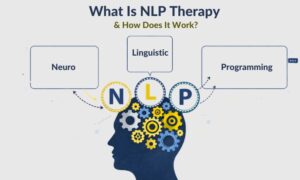
Neuro-Linguistic Programming (NLP) is a meta-scientific model that maps the link between neurological processes, language, and behavioural actions. It was developed in the 1970s by Richard Bandler and John Grinder.
Though NLP therapy is not completely scientifically proven, these are a set of models that have been validated by thousands of beneficiaries across the globe. NLP is not just another therapy; it’s a practical toolkit for transforming your mind.
NLP says that we experience our life with sensory representations, such as:
- Visuals
- Auditory
- Kinesthetic
Our brain stores this as data and create its memories. They work like software codes and it is also possible to change them. Neuro linguistic programming courses are widely used in corporate training, coaching, and therapies to uplift performance, efficiency, and employees’ personal growth.
How NLP Helps Change Your Mindset?
Here are some ways how NLP helps in changing your mindset with internal transformation.
- Reprogramming Limiting Beliefs
NLP’s core belief transformation process focuses on your beliefs, values, and attitude. The specially designed NLP course in India focuses on uncovering the root belief system and reframing them with a slow and steady procedure.
- Improving Self-Confidence
NLP therapy often boosts your brain’s resource state by attaching positive emotions with regular senses, visualisation, and gestures. This helps individuals to mirror the neuron activities that often boost morale and confidence.
- Changing Thought Patterns
The NLP programming also focuses on replacing the negative visuals with positive ones. This changes the core elements of thought chains. As a result, it breaks the chains and improves the prefrontal cortex activities.
- Better Emotional Control
NLP’s speciality is reframing the preset data and nullifying the triggers. NLP often use the meta-states technique, where it fills emotions about emotions in your mind and alters the results after that.
- Goal Clarity and Focus
An NLP practitioner certification can help you with setting SMART goals with sensory checks. Moreover, a clear, well-structured mind map helps perceive, analyse, and win everyday leadership challenges.
Popular NLP Techniques for Mindset Change
The best NLP trainer in India, Himanshu Gaur, has been actively helping corporates and businesses enhance their efficiency, performance, and personal growth. Here are some of the top NLP techniques he suggests:
- Anchoring: This technique associates a physical cue with peak positive states for instant recall and performance.
- Reframing: Reframing techniques shift the context of an event. For example, reframing “failure” as “feedback” to alter its meaning and your mind’s response to it.
- Meta Model: Meta model challenges the vague language that we use every day to reveal the distortions we carry with us.
- Visual Squash: The Visual Squash technique integrates the conflicting parts of our mind and combines them for a better outcome. This aligns your internal world and pushes you for better outcomes in all conditions.
- Timeline Therapy: The timeline therapy helps you to visualise the past and the future to break habits and release baggage. This results in new connections, often resulting in new cognitive behaviours.
Tips to Start Changing Your Mindset Today
- Audit self-talk: Start journaling your negative thoughts and reframe those with NLP questions.
- Anchor positives: Recall your successes and add a gesture to encode these as muscle memories.
- Set well-formed outcomes: create a new set of sensory-rich goals, strengthening a positive mindset.
- Practice daily swish: Practice everyday for 5 minutes, twice daily.
- Seek NLP practitioner certification: Lastly, for the best results, find the best NLP trainer for corporate, like Himanshu Gaur.
Remember, consistency is the key here. It decides your intensity, speed, and direction.
Conclusion
Changing your mindset isn’t just about your willpower. It is related to your beliefs, value system, and mind activities. Our mind functions on the basis of past experiences and uses those as data for the future. Old habits, fears, and inconsistencies impact the most and Neuro Linguistic Programming techniques reframe that core wiring.
Whether its self-doubt or peak performance, techniques like Awareness and tools like Anchoring help corporate professionals and business owners boost their efficiency and performance. In this blog, we have discussed how people get stuck to their mindset and struggle to grow but NLP therapy offers a solution that is practical and guided.
Looking for the best NLP trainer for corporate? Connect with Humanishu Gaur today.