Actually, emotions don’t usually give you a warning before they hit. They show up right in the middle of things that really matter, such as meetings, an essential decision, or sometimes even a simple conversation, and silently make an impact on how exactly they respond.
Here, the problem isn’t that these emotions do exist. But most people don’t even know how to control them in the moment. If you ignore or suppress them, it might work briefly, but it doesn’t last.
A better approach is learning how to shift your state as the situation unfolds using Neuro Linguistic Programming Techniques. That’s exactly where NLP anchoring helps. It’s the approach that gives you a way in order to truly bring calm, focus, or confidence when you actually need it.
What Is Neuro Linguistic Programming Anchoring?
Before even jumping into another example, it’s really essential to see What Is NLP Therapy and what’s really happening here.
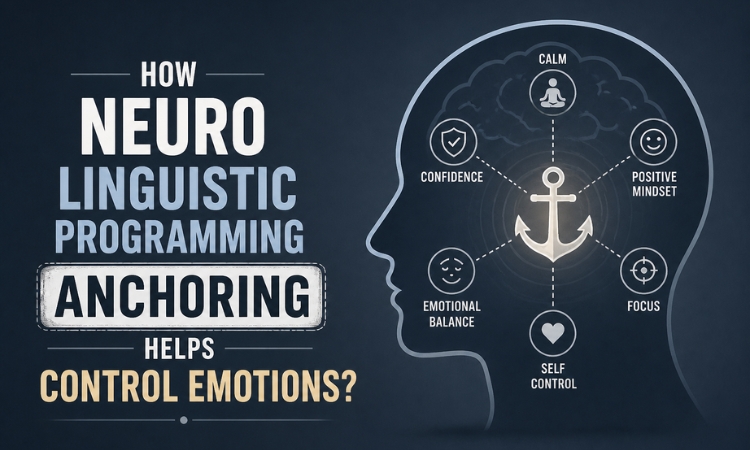
Anchoring works by creating a connection between a specific trigger along with an emotional state. Your brain learns this connection thoroughly by repetition. Once the link is strong enough, the trigger alone has the potential to bring back that same feeling. It’s not all about forcing a reaction; it’s about training your mind in order to respond in a certain way.
Now, let’s look at a simple example:
Just imagine someone who feels totally anxious before he/she attends social media events. The person’s mind automatically overthinks, hesitates, along with discomfort. However, they also have some moments in life where they’ve really felt relaxed and at ease, maybe while the person is spending time with close friends.
In NLP anchoring, he/she takes that relaxed state and then connects it with a small action like gently pressing their wrist or sometimes a specific deep breath.
They repeat this while fully experiencing that calm feeling.
Later, before entering a social situation, they use the same action.
Instead of anxiety taking full control, their mind starts shifting toward that familiar sense of ease.
That’s anchoring.
It doesn’t erase the situation, but it changes how you respond to it.
How NLP Anchoring Helps Control Emotions?
Emotional control is less about suppressing feelings and more about managing how you respond to them. This is where NLP anchoring techniques become useful, especially when learned through online NLP courses. They help you shift your emotional state in the moment, instead of reacting automatically.
Emotional control is less about suppressing your feelings. It’s more about handling how exactly you respond to them. That’s also where NLP anchoring techniques become useful.
Creates Positive Emotional Triggers
Anchoring gives you the ability to produce purposeful emotional reactions. You do not need to wait until you feel confident or calm to do so; you can induce that condition by means of a particular action, such as a gesture or word. As you practice, your mind will begin to associate that trigger with the desirable emotion, and hence it becomes easy to get when you need it.
Reduces Negative Emotional Reactions
Stress and anxiety tend to adhere to automatic patterns. Anchoring is useful in breaking such a cycle. Once you activate a positive anchor at a stressful time, it helps to shift your attention and to diminish the levels of negative emotions. This renders it a feasible method to those who are considering NLP as a means of relieving stress.
Improves Self-Awareness
Exercising anchoring will make you more conscious of your emotional patterns. You begin to realize what causes some of your reactions and how you can modify them. This heightened consciousness is important in the development of emotional intelligence.
Enhances Performance in Challenging Situations
Emotions may influence performance in stressful situations such as interviews or presentations where the pressure is high. Anchoring will help you to remain composed and focused because it will enable you to get into the appropriate emotional state at the appropriate time. That is why it is frequently employed in the NLP confidence techniques and performance coaching.
Step-by-Step Process of NLP Anchoring for Emotional Control
It is the proper application that really makes things happen. It is easy to do, yet how you do each one is what counts. This can be a consistent method of controlling emotions, should it be done with focus and regularity.
Step 1: Identify the Desired Emotional State
Start with clarity. Questions to ask yourself are what you really want to feel in a particular situation.
It may be confidence prior to presentation, composure during stress, or concentration at work. Avoid being vague. The more vividly you are able to define the emotion, the easier it will be to recreate the same emotion with your mind.
Rather than saying, I want to feel better, make a decision that is specific, such as, I want to feel calm and in control.
Step 2: Recall a Strong Positive Memory
Now imagine a real-life situation when you were truly experiencing that feeling.
You must not remember it by chance. Enter into that memory. Record what you saw, what you heard, and how you felt about it at that time. The aim is to reawaken that feeling as intensely as possible.
The more intense the feeling, the more your anchor will be. When the emotion is perceived as being weak, the anchor will not be of much value.
Step 3: Choose an Anchor (touch, word, or gesture)
Select an easy and reproducible trigger. This may be pinching your fingers together, touching your wrist, or simply murmuring a particular word.
Make it delicate and original. It must not be something you do randomly at different times of the day, otherwise the connection will be compromised. Consistency matters here. Always use the same anchor.
Step 4: Repeat and Reinforce the Anchor
At the time when the emotion is at its highest level, then activate your desired anchor.
Keep it for a few seconds and then let go. This should be repeated several times using the same memory or even different memories of the same emotion.
It is this repetition that creates the linkage in your mind. A single effort is not typically sufficient. The stronger you reinforce it, the stronger and quicker is the response.
Step 5: Test and Apply in Real-Life Situations
Once you’ve practiced, it’s time to test it. Apply your anchor in a case where you really need that emotional condition. Notice the shift. It might not seem ideal at the beginning but even the slightest change will mean that it is working. The response will become more natural and reliable with repeated use.
Practical Examples of Neuro Linguistic Programming Anchoring
The following are actual, high-value anchoring applications that can actually be applied in real life, not just in theory:
- Before high-stakes moments (presentations, interviews)
Rather than wishing that confidence would appear, you activate a pre-constructed anchor that is associated with a previous success, which helps you to talk clearly and stay calm in a crisis.
- Interrupting anxiety before it builds up
As soon as you begin to experience the first symptoms of anxiety, you trigger a calmness anchor, preventing the emotional spike before it takes full control.
- Re-setting the focus in deep work
When distractions interfere with your concentration, a focus anchor will help you resume a productive mental state quickly, without wasting time trying to get yourself back into the zone.
- Dealing with emotionally charged discussions.
An anchor can make you feel level in an argument or a sensitive discussion, and thus, you would respond to the discussion rather than reacting to it.
- Shifting out of overthinking at night
When your brain begins to race before sleep, a relaxation anchor will assist in slowing your thoughts and bringing your body to a more relaxed state.
Benefits of Neuro Linguistic Programming Anchoring
Neuro Linguistic Programming Anchoring is appreciated due to its simplicity, practicality, and the possibility of managing your emotional condition in real time, making it one of the key Neuro Linguistic Programming Benefits. As you use it on a regular basis, it begins to produce some visible changes in your thinking and your reactions.
- Better emotional control: Makes you respond, not react, like most of the other excellent emotional control strategies.
- Calms down stress and anxiety: Applicable to NLP to relieve stress and use NLP to relieve anxiety in real-life circumstances.
- Develops confidence when required: One of the most common uses of NLP is to reach a confident state at the right time.
- Improves emotional intelligence: Raise awareness of your emotional patterns, which helps support NLP in terms of emotional intelligence.
Improves concentration and performance: Helps you to be more present and work better in high-pressure situations.
Conclusion
Neuro Linguistic Programming Anchoring is a very simple yet effective method of controlling your emotions in a more conscious and controlled way.
It can make you react better, remain calm in situations of pressure, and develop confidence in real-life situations, as it can help you respond better with regular practice.
If you want to learn it with the right guidance, then Himanshu Gaur, the best NLP trainer in India, can guide you to understand and apply these techniques in a practical and effective manner.